
Mozzie Lake
Highlights
- The 26,073.5ha Mozzie Lake Project lies within the Charlebois–Higginson Lake Uranium District, 25km to the northeast of the Athabasca Basin
- While historic mineral resource estimates were identified on numerous pegmatite deposits within the District, exploration has been sporadic since the 1950's
- Uranium mineralization at Mozzie Lake is hosted within pegmatite intrusions at the 20A Zone and the Pinkham Lake showings, with an historic resource defined at the 20A Zone
- Further, historic references note rare-earth-element (REE) bearing minerals in the region, including at the Pinkham Lake showings
Overview
The Mozzie Lake project consists of two properties situated approximately 25km northeast of the Athabasca Basin, located within the Charlebois–Higginson Lake Uranium District. Uranium mineralization on the properties is hosted within pegmatite intrusions.
Pegmatite deposits of the Charlebois–Higginson Lake Uranium District have remained largely dormant since it was first explored in the 1940's. There are historical references to rare-earth-element (REE) bearing minerals in the region, including at the Pinkham Lake prospects on the Mozzie Lake property. Atomic believes that a re-evaluation of the district with respect to REE mineralization should be conducted to potentially bolster the uranium potential of the project.
Atomic is targeting basement-hosted uranium at Mozzie Lake.
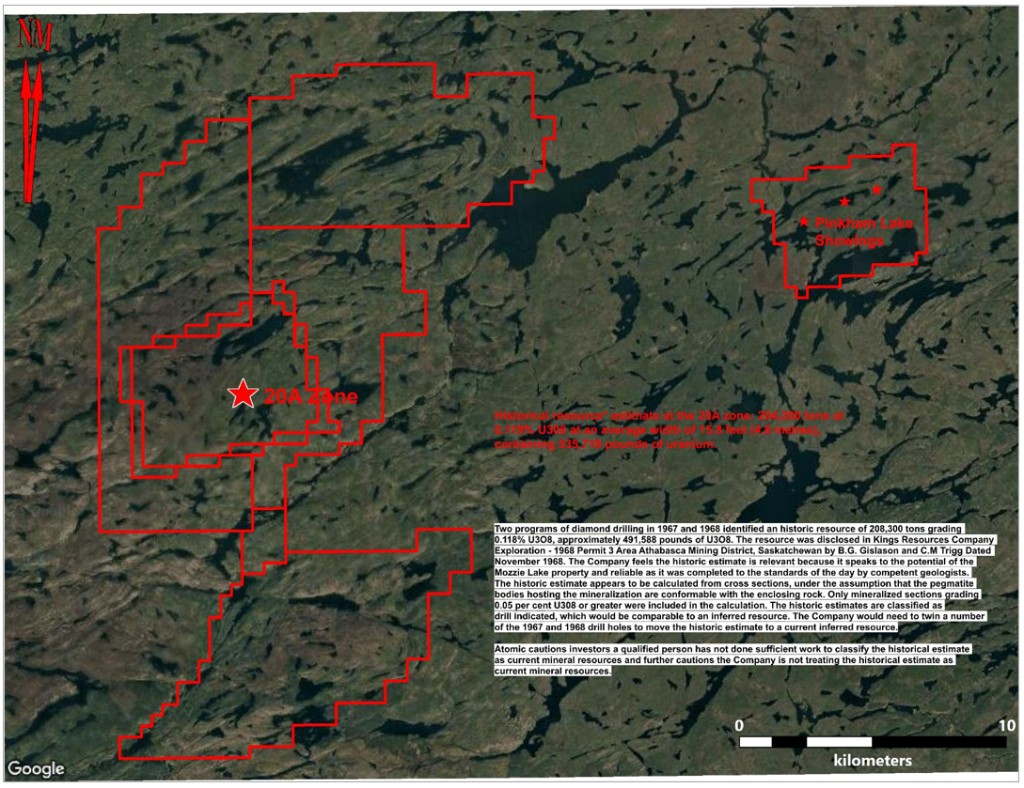
*Two programs of diamond drilling in 1967 and 1968 identified an historic resource of 208,300 tons grading 0.118% U3O8, approximately 491,588 pounds of U3O8. The resource was disclosed in Kings Resources Company Exploration - 1968 Permit 3 Area Athabasca Mining District, Saskatchewan by B.G. Gislason and C.M Trigg Dated November 1968. The Company feels the historic estimate is relevant because it speaks to the potential of the Mozzie Lake property and reliable as it was completed to the standards of the day by competent geologists. The historic estimate appears to be calculated from cross sections, under the assumption that the pegmatite bodies hosting the mineralization are conformable with the enclosing rock. Only mineralized sections grading 0.05 per cent U308 or greater were included in the calculation. The historic estimates are classified as drill indicated, which would be comparable to an inferred resource. The Company would need to twin a number of the 1967 and 1968 drill holes to move the historic estimate to a current inferred resource.
Atomic cautions investors a qualified person has not done sufficient work to classify the historical estimate as current mineral resources and further cautions the Company is not treating the historical estimate as current mineral resources.
Basement-Hosted Uranium
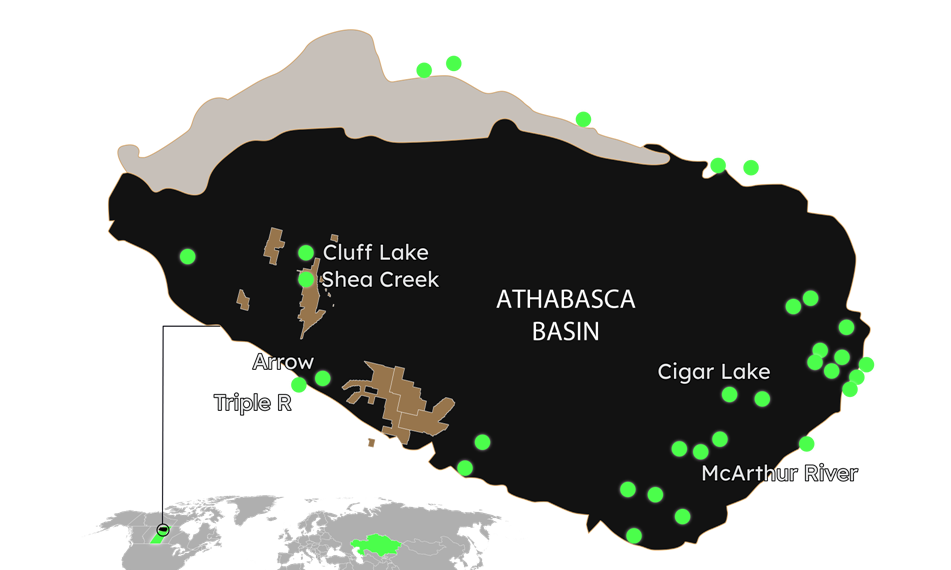
The 100,000 km² Athabasca Basin is the largest uranium province in Canada, with an estimated 1.5-billion-pound endowment and 985 million pounds produced through 2022.2,3
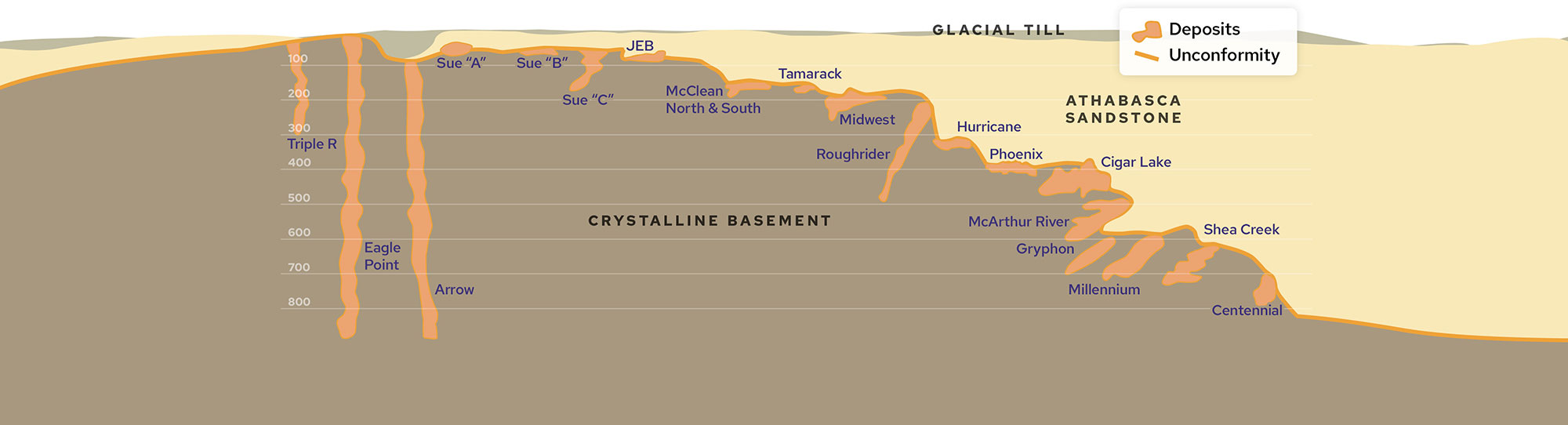
Uranium is found in three distinct settings within the basin:
- At the sandstone / basement unconformity: Hurricane, Phoenix
- In the overlying sandstone: JEB
- In the underlying basement rock, both under and outside of the sandstone cover: McArthur River, Roughrider; Triple R, Arrow
Atomic's 26,073.5ha Mozzie Lake Project lies in the basement rock, north of the sandstone cover, with two mineralized areas: the Zone 20A (with an historic resource) and the Pinkham Lake showings.